THE CASE FOR MFC HAS CHANGED
Why MFC could now be right for your operation.
Previously dismissed MFC as too expensive, complicated or difficult to integrate? Advances in production technology, economics and practical implementation make it worth another look. Whether you’re considering MFC adoption for the first time or previously ruled it out, there’s good reason to take another look.
Microfibrillated cellulose (MFC) has demonstrated valuable properties in paper, board and packaging for many years. Yet for many producers, concerns about production costs – whether procuring or producing, equipment reliability, mill integration, regulatory requirements and access to meaningful trials have made MFC difficult to justify. Now, FiberLean’s MFC grinders give producers a compelling financial reason to look again.
FiberLean’s industrial MFC grinders enable on-site production with typical conversion costs of €150–350 per dry tonne of MFC, opportunities to save more than €20 per tonne of paper or board, and an illustrative production cost including pulp of around €1,050 per dry tonne – up to 50 times lower than selected delivered merchant MFC prices. The commercial case for producing MFC on site deserves renewed attention.
The MFC adoption case extends beyond cost, too. FiberLean has also addressed historical obstacles around equipment reliability, regulatory clearance, access to meaningful trials and integration into production. Together, these advances are helping overcome the challenges that have historically held back adoption, giving producers a practical route to evaluate MFC, quantify its value and produce it in-house.
Case studies and production trials demonstrate what MFC can deliver. The question is no longer simply whether MFC works. It’s whether the technology, performance and economics now make sense for your operation. FiberLean combines grinder technology, application expertise and a staged evaluation process to help producers make that decision.
typical pulp-to-mfc conversion cost (dry tonne)
potential paper/board saving in documented cases
illustrative pulp-inclusive cost / dry tonne mfc
Explore what’s changed, get practical answers to common concerns, and see how you can evaluate MFC before committing to industrial production.
Why MFC is worth another look.
Perhaps you’ve considered MFC in the past and concluded it was too expensive, too complicated or too risky to introduce. Or you’re exploring it for the first time and questioning whether it could work in your operation.
From production costs and equipment reliability to integration, trials and regulatory requirements, FiberLean has developed practical solutions to many of the challenges that have historically slowed MFC adoption.
Here are four important reasons why the case for MFC has changed.
Reliable equipment. Practical integration.
Proven industrial grinders designed for dependable continuous operation, with modular configurations and integration support.
More affordable MFC production.
On-site production changes the economics, with typical conversion costs of €150–350 per dry tonne of MFC, excluding feed pulp.
Food-contact regulatory progress.
Established regulatory clearances and supporting evidence for specified uses and markets provide a clearer route to evaluating food-contact applications.
Meaningful trials before investment.
Access to representative MFC samples and multi-tonne quantities enables manufacturers to test performance and assess value before committing to equipment.
Practical solutions and supporting evidence
Ten key developments that have changed the case for microfibrillated cellulose, and made MFC adoption a key opportunity for your operation.

On-site production designed around your operation.
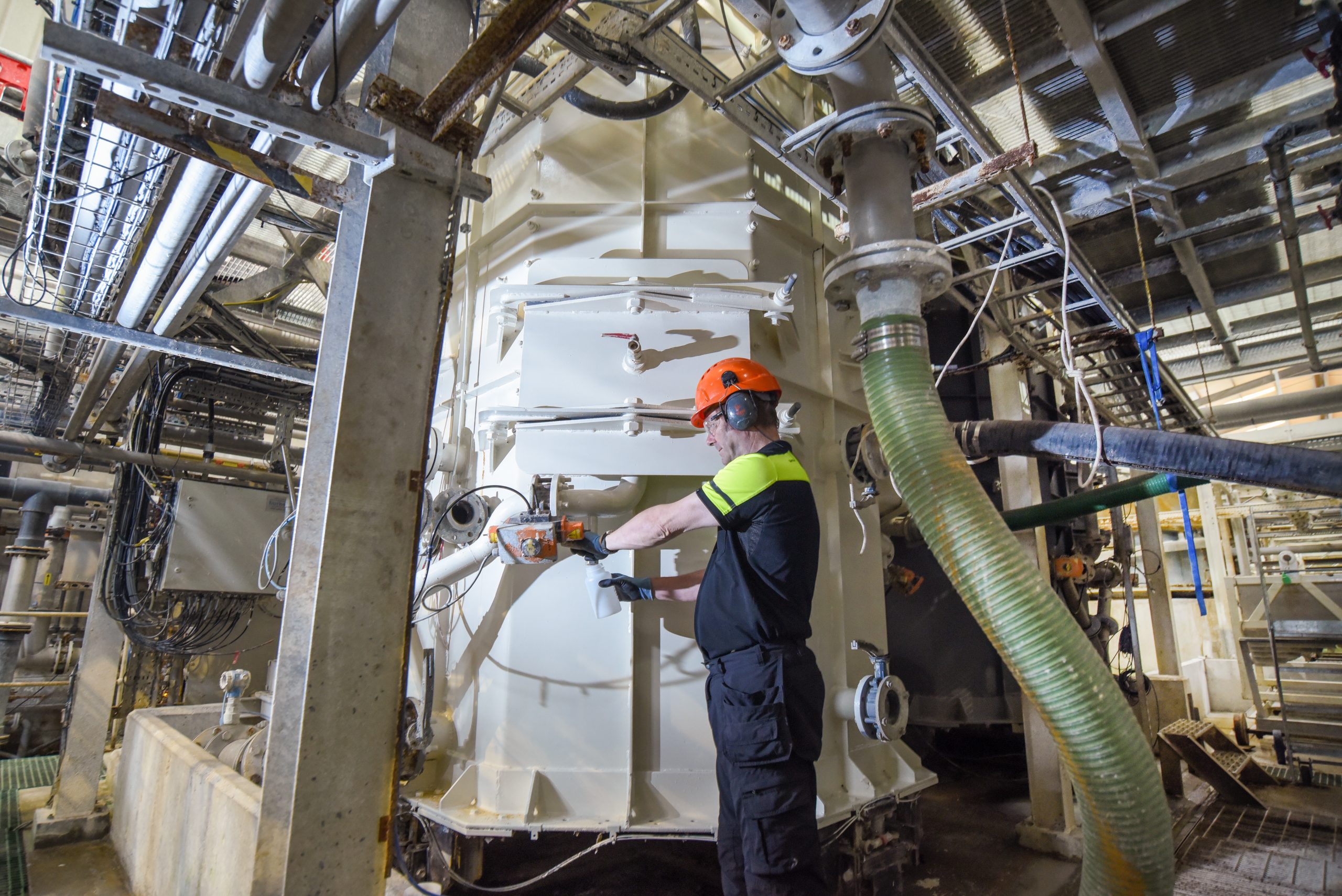
FiberLean’s modular grinders can produce fresh MFC close to where it is used. Before installation, the team works with you to establish how the pulp will be prepared, where the MFC will be added and how it will be handled and controlled.
FiberLean’s three grinder sizes cover different output requirements. Multiple grinders can share infrastructure where more capacity is needed. The installation is designed around the space, utilities and suitable systems already available on site.
FiberLean supports equipment engineering, commissioning, start-up and operator training. Application work checks how the MFC interacts with the furnish, including retention, drainage and wet-end chemistry. Using existing infrastructure where practical and selecting equipment for the required output helps keep the investment focused on what the operation needs.
Reliable continuous production with limited supervision.
FiberLean’s stirred media grinders are built for continuous MFC production. Inside a robust vessel, an agitator accelerates ceramic grinding media that fibrillate the pulp. The process does not rely on maintaining precision refiner plate gaps or forcing material through narrow processing orifices prone to blocking.
Automated controls maintain the selected energy input. Grinding media are automatically topped up as they wear while production continues. Door screens are replaced during planned stops.
Typical grinder availability is 98.3%, including the door-screen replacement regime. Grinders run with limited supervision, and their controls and alarms can connect to the mill’s existing control system.
For producers, that means consistent output with less routine intervention. Both matter when calculating how much MFC the equipment will produce and what it will cost to operate.
Trial MFC before investing in a grinder.
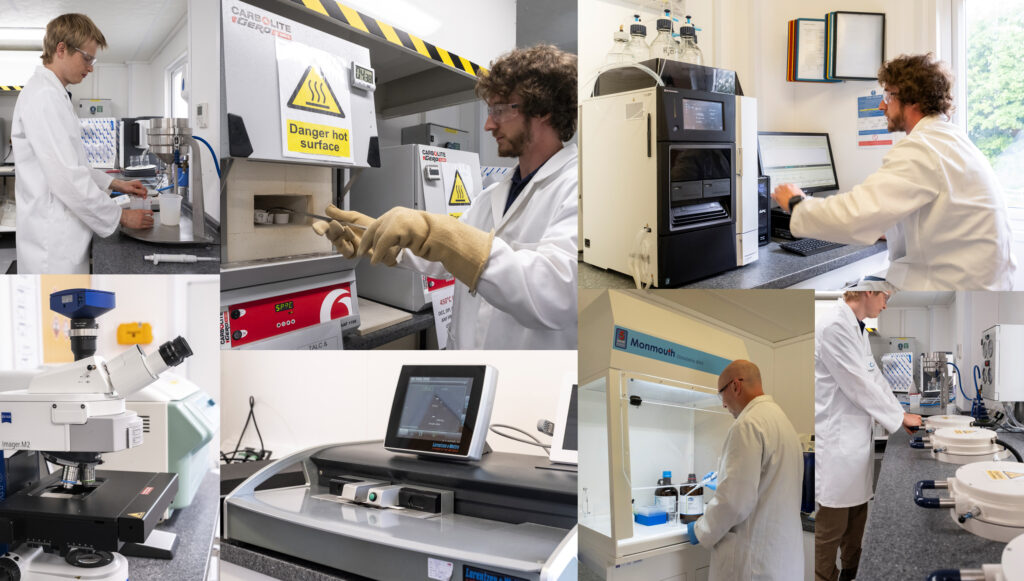
You can test FiberLean grinder-produced MFC before buying equipment. Our Cornwall production facility in the UK supplies samples and multi-tonne quantities for development and production trials, with material available at approximately 20% solids for trials and interim supply.
MFC from FiberLean grinders has been evaluated in more than 100 full-scale papermaking trials. That experience helps the team plan what to measure, which addition rates to test and how to compare results with your existing product and process.
The trial is where the financial proposition becomes specific to your operation. It establishes the MFC dose, the product or process improvements and their value before you commit to equipment.
On-site production changes the cost of using MFC.
Buying MFC can be useful for development trials and temporary supply. For ongoing production, making it on site can change the economics substantially.
FiberLean’s typical pulp to MFC conversion cost is €150–350 per dry tonne of MFC. The illustrative cost including feed pulp is around €1,050 per dry tonne – up to 50 times lower than selected delivered merchant MFC prices.
On-site production removes the need for regular deliveries of finished MFC and dependence on a merchant selling price. Where a suitable pulp is already available, MFC production can use the producer’s existing fiber supply and handling systems.
The comparison needs to include pulp, electricity, grinding media, screens, maintenance and installation costs. It also needs to account for how much MFC achieves the required result – different MFC materials may need different doses.
The scale of the potential difference gives producers a reason to reconsider MFC’s affordability. For paper and board producers, the next question is what that translates into per tonne of finished product.
MFC tuned to the performance your application needs.
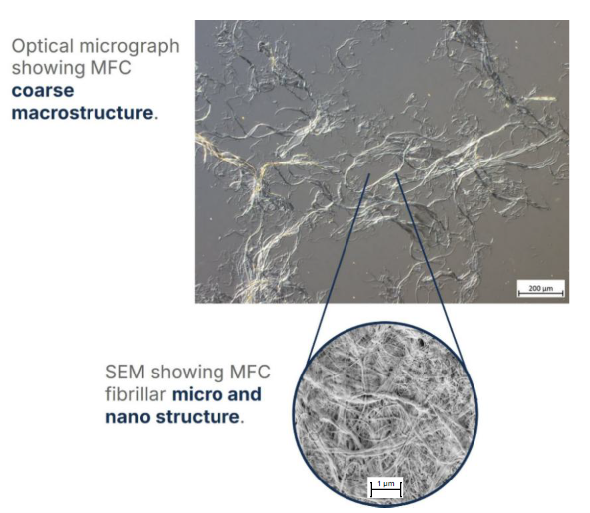
MFC is not one fixed material. Its structure and performance depend on the starting pulp and how it is processed. FiberLean adjusts grinding media properties and energy input to make MFC for the result you need.
For many in-furnish uses, the aim is a highly fibrillated surface within a coarser connected network. Fine fibrils provide the bonding surface; the larger structure bridges between fibers and other particles and helps retain the MFC during papermaking. Some coating uses need a finer structure.
What the comparative laboratory evidence shows.
In laboratory handsheet studies, FiberLean grinder-produced MFC showed potential dose savings of about 30% for equivalent sheet porosity and about 15% for equivalent tensile strength compared with refiner-produced MFC. FiberLean grinder-produced MFC matched the performance of refiner-produced MFC for Scott Bond internal bond strength.
These were laboratory studies with near-complete MFC retention. The benefit depended on the property being measured. FiberLean has not yet conducted direct back-to-back full-scale comparisons with refiner-produced MFC, so production trials are needed to measure the benefit in your application.
Where a lower dose achieves the same result, less MFC needs to be produced and added. That can improve the economics, but the saving must be calculated from the dose and production conditions that work for your product.
Fully mechanical production without pretreatment.
FiberLean produces MFC mechanically, without requiring chemical or enzymatic pretreatment of the pulp. Collisions between grinding media fibrillate the fibers in an aqueous suspension.
The process can be assessed alongside your existing pulp preparation and handling systems. This describes how the MFC is made; any other ingredients in the furnish, coating or finished product depend on the application.
Avoiding a required pretreatment stage simplifies MFC production. We will support you in assessing how the financial value of in-house MFC production sits alongside other preparation and processing steps your application requires.

Regulatory and safety questions addressed with evidence.
FiberLean has extensively investigated how grinder-produced MFC is made, handled, used and assessed after use. Clearances have now been achieved for many uses. The work covers occupational exposure, physical and chemical properties, toxicology, nanomaterial classification, food contact and end-of-life testing.
Independent specialists have contributed to this work, including regulatory expertise from Vireo Advisors. FiberLean can help you identify the supporting documentation for the material and intended use. The documentation needs to match your product, market and production arrangements. FiberLean’s team can help you establish which specifications and conditions apply, and provide relevant documentation.
More choice in the pulp you use.
FiberLean grinders can process a range of suitable chemical pulps. You can evaluate a pulp already used in your operation alongside other sources.
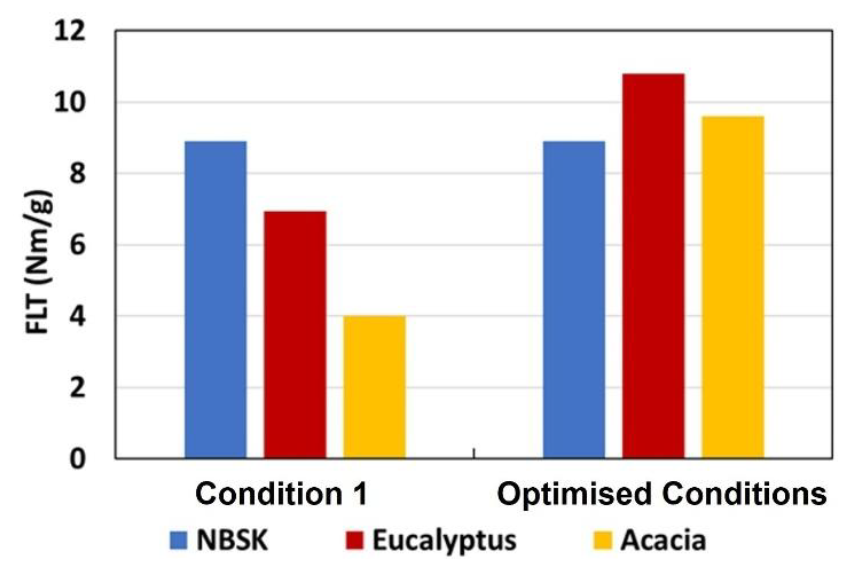
Laboratory comparisons of northern bleached softwood kraft, eucalyptus and acacia show why the grinding conditions matter. Settings optimised for softwood were less effective for the two hardwood pulps. At the same energy input, adapting the settings to each fiber enabled the shorter hardwood pulps to achieve comparable or higher results in FiberLean’s in-house high-mineral-loading tensile test.
That flexibility can help you make better use of available pulp and control the cost of making MFC. Feed pulp is a separate cost from the quoted €150–350/t conversion cost, so its choice matters to the full production calculation. We’d be happy to explore the the options available to you, get in touch here.
The right balance of energy, quality, and output.
FiberLean has extensively investigated how grinder-produced MFC is made, handled, used and assessed after use. Clearances have now been achieved for many uses. The work covers occupational exposure, physical and chemical properties, toxicology, nanomaterial classification, food contact and end-of-life testing.
Independent specialists have contributed to this work, including regulatory expertise from Vireo Advisors. FiberLean can help you identify the supporting documentation for the material and intended use. The documentation needs to match your product, market and production arrangements. FiberLean’s team can help you establish which specifications and conditions apply, and provide relevant documentation.
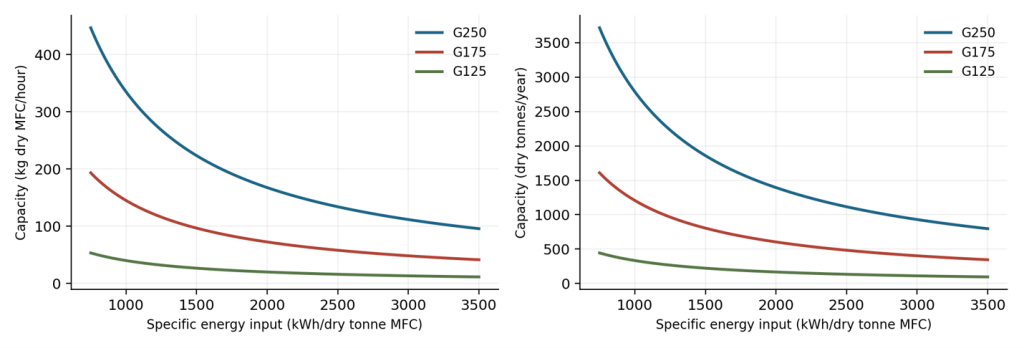
Grinder | MFC capacity at 3,500 to 750 kWh/t | MFC annual capacity |
|---|---|---|
11.4–53.3 kg dry MFC/hour | 95–444 dry tonnes/year | |
41.4–193 kg dry MFC/hour | 345–1,609 dry tonnes/year | |
96–447 kg dry MFC/hour | 797–3,717 dry tonnes/year |
At 2,000 kWh per dry tonne, for example, a G250 has a calculated output of approximately 168 kg dry MFC/hour, or 1,394 dry tonnes/year on the stated annual basis. Capacity figures therefore need to include the energy input and operating assumptions.
FiberLean helps you assess energy use, MFC dose, drainage and output together, then select equipment for the production requirement.
The objective is to achieve the required product performance at an attractive cost. Choosing the right grinding conditions helps control electricity use and the amount of MFC needed – both central to the low conversion-cost proposition.
Savings you can assess before investing.
The financial opportunity from in-house MFC production is substantial. Conversion costs of €150–350 per dry tonne of MFC and potential savings of more than €20 per tonne of paper or board. For relevant merchant-supply comparisons, the illustrative pulp-inclusive on-site cost of around €1,050 per dry tonne can be up to 50 times lower than selected delivered merchant prices.
The value comes from what MFC changes in your product and process. Improvements in strength, porosity and other properties can allow changes to the furnish, lighter products, process savings or new product development.
Trials measure those benefits alongside MFC dose, retention and drainage. The investment calculation then combines the results with pulp, electricity, consumables, maintenance and the full installation cost. That gives you a business case based on your operation, with the target benefits measured before scale-up.
Large savings need a clear explanation. A cost breakdown and supporting application results show how the figures are built and help you judge what they could mean for your own production.
from evaluation to implementation
Find out what MFC could deliver for your operation.
The production technology, trial material and expertise are available. The next step is to establish what FiberLean grinder-produced MFC could save or improve in your operation. FiberLean helps you work through each stage, from deciding what to test to assessing the investment and bringing production on site.
Discuss your application
Evaluate representative MFC
Run a production trial
Quantify performance and value
Select equipment
Design & commission on-site production
Your questions about adopting MFC
Can we evaluate MFC before buying a grinder
Yes. FiberLean can supply samples and multi-tonne quantities for development and production trials. The team agrees the material, quantities and handling arrangements with you.
Can we use our own pulp
Yes, a suitable chemical pulp from your own supply can be evaluated. Testing establishes the grinding conditions and whether it delivers the MFC performance you need.
Can food contact clearance apply to MFC made at our mill
The applicable clearance needs to be checked for your market and production arrangements. FiberLean can help identify the material specifications, production guidance and documentation required. Buying a grinder alone does not establish regulatory coverage.
Does easier adoption mean a better return
The return depends on your grade, MFC dose, operating conditions and installation cost. FiberLean helps you measure the benefits through trials and use the results to assess the investment.
How does MFC fit PFAS free packaging development
MFC can contribute to selected grease-resistant or multilayer barrier structures. Performance depends on the formulation and complete packaging construction. Testing needs to establish that it meets the intended barrier and food-contact requirements.
Ready to take another look at MFC?
Tell us what you produce, what you want to improve and where cost or performance is holding you back. We can help you evaluate suitable MFC, assess its performance in your process and understand the technical and commercial case for producing it on site.